

The ultimate AI shift is here: AI Agents are no longer assistants but decision-makers.
About a decade ago, the first wave of Artificial Intelligence (AI) introduced everyone to data-driven intelligence and predictive insights. Then came Generative AI, a technology that impressed everyone by automating content generation and serving as a powerful “copilot.” But the current frontier – Agentic AI – has redefined intelligence and content generation by adding a layer of autonomy.
An AI Agent doesn’t just predict outcomes, answer a question, or draft a document. It chases a goal, breaks it down, makes a plan, executes the necessary actions across multiple systems, and learns from the results at each phase.
For organizations, taking this leap from adopting AI as a “copilot” to a “decision-maker” demands proper planning and a thorough AI strategy. Since the majority of Agentic AI projects are currently early-stage experiments, the mandate is clear: enterprises must proactively assess and evaluate their production readiness for Agentic AI before scaling these projects.
This blog outlines a definitive framework for assessing Agentic AI readiness and evaluating use cases. We also detail a foolproof Agentic AI adoption strategy and outline the essential metrics you must track.
Table of content
The Current State of Agentic AI Adoption: Hype vs. Execution
Agentic AI was arguably the most talked-about concept in enterprise AI in 2025. Every vendor mentioned it. Every conference featured it. Every CTO talked about their Agentic AI roadmap.
According to McKinsey’s State of AI 2025 report, over 23% of organizations reported that their enterprises are expanding Agentic AI adoption across at least some of their workflows. Another 62% reported experimenting with AI Agents in at least one business function.
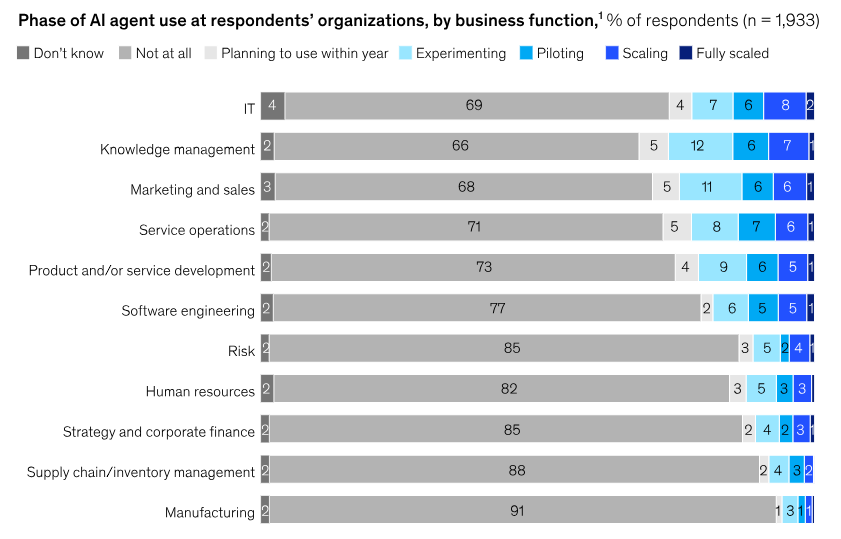
This surge of interest, however, highlights a clear divide between enthusiasm and execution. Within this divide, many organizations are grappling with:
Misapplied Agentic AI Capabilities
Many organizations hopped on the AI Agent bandwagon, but for entirely unvalidated use cases. Agentic AI adoption is required for multi-step goals that demand dynamic planning and execution across various systems. Most business problems, however, can be solved by simpler, more mature technologies.
- If the goal is to extract specific details from invoices, basic Document AI/OCR (Optical Character Recognition) technology can work.
- If you want to generate initial drafts, it falls squarely within the scope of Generative AI’s ‘copilot’ function.
- If you want to automate basic, repetitive workflows, it is a part of RPA.
TL;DR – Not everything calls for Agentic AI adoption.
Agentic AI Washing
The market is now flooded with products claiming to be “Agentic AI” that are, in fact, simple chatbots or rebranded robotic process automation (RPA) tools—a phenomenon Gartner terms “agent washing.” This created immense confusion for enterprise AI leaders. CTOs and CEOs risk significant investment in capabilities they already possess or in technology that falls far short of their expected AI business value.
Failure Anticipation
Existing results are a sharp reality check. Gartner predicts that over 40% of all Agentic AI projects will be canceled by the end of 2027 due to escalating costs and unclear ROI expectations (as of now). This is because the technology is not yet mature enough to reliably deliver the AI business value that companies expect in realistic production environments and at scale.
Plus, we are currently at the Proof of Concept (PoC) stage, and concepts often fail. Each failure helps leaders filter out the Agentic AI hype from its actual potential. PoCs that survive (the ones that demonstrate clear, measurable ROI and can scale) are valuable.
The takeaway for every enterprise AI leader is to pursue autonomous AI Agents only where their planning and action-taking capabilities are absolutely required to unlock high-level AI business value.
What Should You Do: An Honest Agentic AI Readiness Assessment
Instead of giving in to the hype around enterprise AI adoption, enterprises must pause and think. They should conduct a thorough, honest assessment of their Agentic AI readiness for successful integration.
Here is a validated, self-audit framework that can help you assess your organization’s Agentic AI readiness. Use it to:
- Identify infrastructural bottlenecks
- Evaluate the state of your data
- Spot governance gaps
- Prioritize investments
Requirement Analysis
Begin by determining if Agentic AI capabilities align with your long-term goals and priorities.
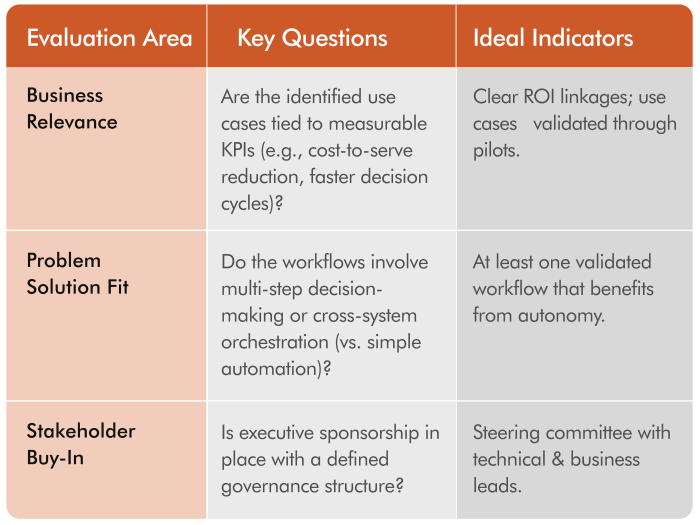
Action Imperative: Proceed with the assessment if 2 of 3 evaluation parameters are met.
Data & Infrastructure Readiness
Agentic AI needs high-quality, engineered data for processing and decision-making. Evaluate whether your existing business data is ready for AI model training. You should also assess where this data is stored. For maximum AI business value, Agentic AI should have access to clean and consolidated data stored across interoperable systems.
Additionally, assess transactional throughput and latency. Can your current infrastructure support a minimum of 50 transactions per second with sub-500-ms response times for the Agentic AI system to execute its planned actions? Refer to the following to make this assessment:
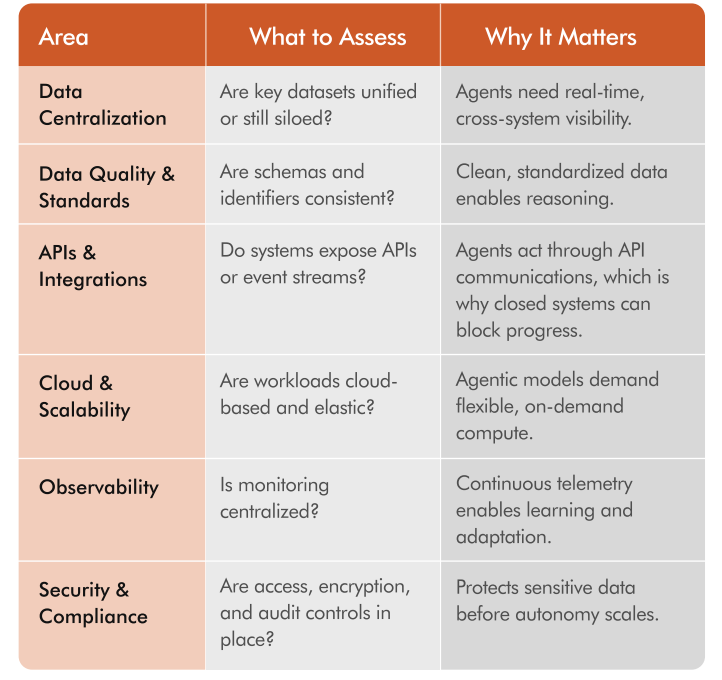
Action Imperative: It would be advisable to invest in an AI-first data infrastructure before proceeding with Agentic AI adoption. Work on consolidating high-quality data, establishing API-based communications, setting up logging and monitoring, and moving your workloads to the cloud (AWS, Azure, Google Cloud, etc.) for faster, more efficient processing.

Organizational Structure & AI Governance Framework
Agentic AI adoption is much more than a technology upgrade. Assess whether your teams and governance structures can support the operational complexity that comes with Agentic AI adoption, as these systems typically do not belong to a single department (e.g., “IT” or “Marketing”).
Moreover, the shift from a human doing the task to an Agentic AI system taking it over also raises concerns about being replaced while creating critical new roles for monitoring and oversight. Plan how you will navigate these changing workplace dynamics.
Why it Matters:
Agentic AI changes the traditional workflow dynamic. You’re no longer validating a static model but an autonomous system that can:
- Initiate tasks
- Trigger downstream actions
- Modify workflows
- Interact with employees, vendors, or customers
Below are a few questions to address when assessing organizational structure and AI governance frameworks:
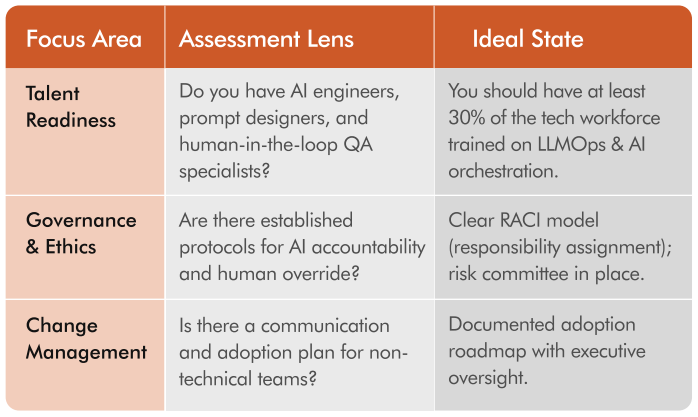
Action Imperative: Note the roles directly impacted and schedule change management workshops to inform people about what their new roles would look like. Train your teams in basic AI principles and human-in-the-loop QA.
In the longer run, aim to establish an AI centre of excellence (CoE) with a cross-functional governance body.
Use Case Validation
Validate your Agentic AI adoption use case to make sure the solution is being designed for realistic, high-value problems where autonomous decision-making is both safe and justifiable. It should improve autonomy under the right constraints while delivering on the right success metrics.
Why it Matters:
It saves you from building AI Agents that:
- Automate a process that should never be automated
- Lack the guardrails required for safe autonomy
- Do not deliver measurable ROI or operational uplift
Below is a mock analysis of how you can validate your Agentic AI use case.
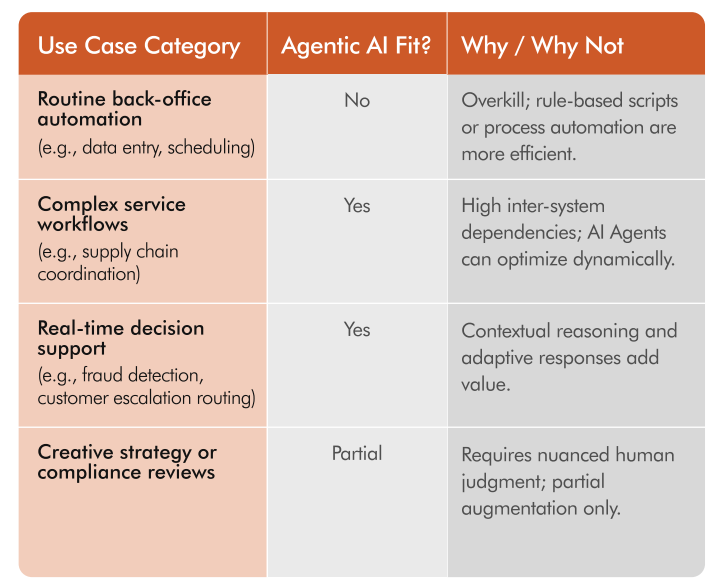
Action Imperative: Begin with 1 or 2 low-impact, high-value use cases for a proof of concept, rather than full-scale Agentic AI adoption. You can also get in touch with Agentic AI consultants to ensure maximum ROI and alignment with your requirements.

Risk, ROI, and Sustainability Mapping
Agentic AI ambition is real, but so is the high failure rate (as of now). By mapping ROI and sustainability metrics, you can ensure measurable AI business value without introducing unacceptable operational, compliance, or long-term maintenance risks.
Why this is crucial for Agentic AI adoption:
This step provides a 360-degree view of feasibility, ensuring that autonomy is introduced only where it is:
- Safe
- Economically justified
- Operationally durable
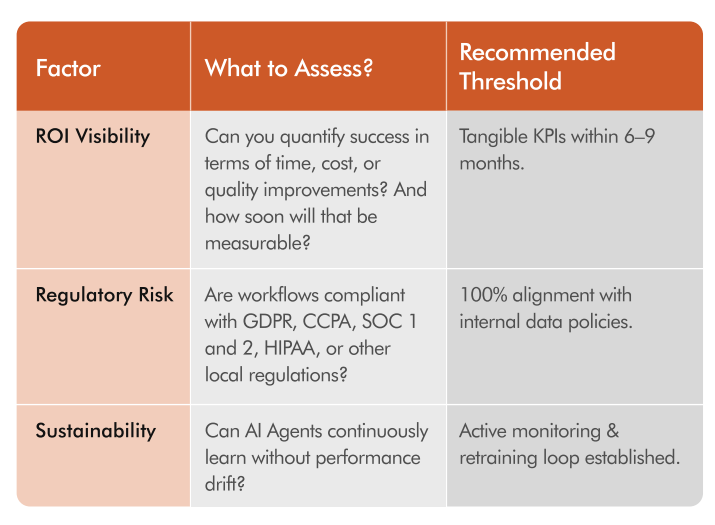
Key Metrics to Track for Agentic AI
Let us take a closer look at key metrics that will help you gauge Agentic AI’s readiness and AI business value once the technology is adopted.
Agentic AI Readiness Metrics (Pre-Adoption)
These metrics measure whether your environment can support autonomous AI Agents before you build or deploy anything.
Data Readiness Metrics
- Data Quality Score: Measures completeness, accuracy, consistency, and validity.
- Data Availability & Accessibility Index: Assesses how easily agents can retrieve required datasets from all systems.
- Data Freshness & Latency Score: Indicates whether data is updated frequently enough for real-time decision-making.
- Structured vs. Unstructured Data Ratio: Shows how much data requires processing or transformation before AI use.
- Annotation/Labeling Coverage: Measures the percentage of training data that is labeled or structured for AI.
System Preparedness Metrics
- API Coverage Score: Percentage of core systems that offer usable APIs for Agentic AI orchestration.
- System Interoperability Score: Measures integration readiness across ERP, CRM, ticketing, and workflow platforms.
- Transaction Throughput Capacity: Can your systems support ≥50 TPS and sub-500ms responses?
- Scalability Index: Evaluates if cloud and compute resources can scale with Agentic AI workloads.
- Monitoring & Logging Maturity Score: Measures the availability of telemetry needed to track agent behavior.
Workforce Readiness Metrics
Measures whether people and teams are prepared for AI Agent-driven workflows.
- AI Literacy & Training Completion Rate: Percentage of teams aware of Agentic AI usage, supervision, and escalation.
- Human-in-the-Loop Capability Score: Evaluates whether teams can supervise, validate, or override Agentic AI decisions.
- Change Management Readiness Score: Assesses cultural openness and process adaptability.
- Cross-Functional Collaboration Index: Determines whether engineering, data, security, and domain teams can jointly manage Agentic AI workflow automation.
Case Feasibility & Value Validation Metrics
Ensures you’re selecting the right Agentic AI adoption use cases.
- Problem–Solution Fit Score: Validates whether autonomy is actually needed.
- Technical Feasibility Score: Evaluates integration complexity, actionability, and boundary definition.
- Expected ROI Predictability: Determines whether the use case has measurable, testable business impact.
Agentic AI Metrics (Post-Adoption)
Measuring Agentic AI performance goes beyond technical and infrastructural validation. You must ensure the Agentic AI system is accessible (and usable) to all users, trusted by them, operationally stable, and delivers sustained AI business value.
The following categories combine validation metrics (model, autonomy, safety) with adoption metrics (usability, trust, scalability, organizational alignment).
Autonomy & Task Performance Metrics
Assess how reliably the agent completes multi-step tasks without intervention. Key metrics to track:
- Task Completion Rate: Shows how consistently the AI Agent finishes assigned workflows.
- Multi-Step Reasoning Accuracy: Measures how well the AI Agent executes chained tasks and logical sequences.
- Task Failure or Abandonment Rate: Highlights breakdown points where the AI Agent struggles or exits prematurely.
- Escalation Frequency: Indicates how often the AI Agent needs human oversight or encounters exceptions.
- Boundary Adherence: Confirms whether the AI Agent stays within defined autonomy limits.
Adoption indicator: Higher autonomy success metrics correlate with user confidence and willingness to deploy Agentic AI systems in more complex workflows.
Safety, Compliance & Risk Metrics
Ensure the Agentic AI system behaves safely, legally, and within organizational constraints.
- Compliance Pass/Fail Rate: Shows alignment with regulatory, privacy, or internal policy rules.
- Out-of-Policy Actions: Identifies potential governance or safety violations.
- Hallucination or Unsafe Output Frequency: Measures the reliability of the agent’s reasoning and responses.
- Incident Severity & Resolution Time: Tracks how quickly issues are identified and mitigated.
Adoption indicator: Lower incident rates increase organizational trust and reduce friction from compliance/legal teams.
Productivity Metrics
Demonstrate business lift and workflow optimization through autonomy.
- Time Saved Per Task: Shows direct time reduction compared to manual execution.
- Reduction in Manual Touchpoints: Indicates how much human effort has been eliminated.
- Throughput or Volume Improvement: Quantifies increased capacity enabled by the AI Agent.
- Average Handling Time Reduction: Measures cycle-time efficiency across workflows.
- Cost Per Task vs Baseline: Assesses financial efficiency compared to human-led processes.
Adoption indicator: Clear productivity gains encourage cross-team rollout and budget expansion.
User Experience & Trust Metrics
Track how employees, vendors, or customers experience Agentic AI adoption.
- User Satisfaction Score: Captures overall sentiment and confidence in the AI Agent.
- Trust/Confidence Rating: Shows whether users believe the AI Agent can be relied on for autonomous tasks.
- Corrections or Overrides/Per User: Indicates the amount of rework caused by AI Agent errors.
- Drop-off or Bypass Rate: Reveals if users avoid the AI Agent due to friction or mistrust.
Adoption indicator: High trust and low correction rates signal the organization is ready for broader deployment.
Tracking these metrics requires a robust network of system telemetry, workflow analytics, and observability tools. This network enables you to monitor their interactions end-to-end, collecting qualitative and quantitative feedback from users and operations teams.
Navigating Agentic AI Adoption: How SunTec.ai Can Help?
At SunTec.ai, we help enterprises navigate the shift from traditional automation to Agentic AI by strengthening the one foundation that determines success: data readiness for AI. Every advanced AI capability, whether agentic or not, depends on high-quality, well-structured, and interoperable data. Our Agentic AI development company’s role is to build that foundation before you decide to scale autonomy.
We do not advocate enterprise AI adoption without validation. Which is why our approach begins with understanding your current data ecosystem, assessing gaps, and mapping what is truly feasible—technically, operationally, and economically.
Where we Fit in Your Agentic AI Adoption Journey
- AI-First Data Preparation: Preparing, labeling, and structuring data specifically for AI.
- Data Infrastructure Modernization: Transforming siloed, legacy datasets into unified, analytics-ready data accessible through ETL/ELT pipelines built for continuous AI workloads.
- MLOps & Compute Optimization: Designing scalable, cloud-native environments optimized for Agentic AI orchestration, telemetry, and model performance.
- AI Validation, Prototyping & Advisor: Running controlled pilots to validate use cases, define autonomy boundaries, and map measurable business impact.
Ready for Agentic AI? Contact us at info@suntec.ai.